.:[Double Click To][Close]:.
Showing posts with label Archaeology. Show all posts

The Only Green-faced Terracotta Warrior Unearthed

green-faced terra cotta warrior

From Xinhuanet

A terracotta warrior with a green face will be shown in the newly revamped Shaanxi History Museum. The terracotta warrior is the only green-faced warrior out of over 1,500 terracotta warriors unearthed so far. The warrior was put in the showcase at the Shaanxi History Museum in Xi'an city of Shaanxi Province on Monday, Dec. 24, 2007.

#Tags: , , ,

Mummified Dinosaur With Clear Remains of Scales Found in North Dakota

Mummified Dinosaur photo

Fossilized hadrosaur Dakota skin picture (Tyler Larson/National Geographic)

The partially mummified hadrosaur [wiki], dubbed Dakota, were found in 2000 by Tyler Lyson, then a 17-year-old boy, on his uncle's ranch in North Dakota.

The creature is fossilized, with the skin and bone turned to stone. But unlike most dinosaur fossils, tissues are preserved as well.

Scientists believed the Dakota hadrosaur should be the most complete dinosaur ever found, with intact skin where clear remains of scales were visible.

"This is not a skin impression. This is fossilized skin," paleontologist Phil Manning of the University of Manchester said. "When you run your hands over this dinosaur's skin, this is the closest you are going to get to touching a real dinosaur, ever." Source: Reuters

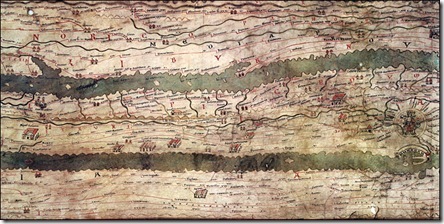
Tabula Peutingeriana, aka Ancient Roman Road Map, Unveiled

Tabula Peutingeriana, Ancient Roman Road Map 

Ancient Roman Road Map: Tabula Peutingeriana (large version)

Tabula Peutingeriana, made in the Middle Ages, is the only surviving copy of a road map from the late Roman Empire. It dates from the late 12th or the early 13th century and was made in Southern Germany or Austria.

The nearly-7-metre-long parchment scroll shows the network of main Roman roads from Spain to India.

At first sight, it looks very unlike a modern map.

Both the landmass and the seas have been stretched and flattened. The Mediterranean has been reduced to a thin strip of water, more like a river than a sea.

Instead of being oriented from north to south, the map, which is only 34 centimetres wide, works from west to east.

At the centre of the Tabula Peutingeriana is Rome. The city, represented by a crowned figure on a throne, has numerous roads leading to and from the metropolis. Some, such as the Via Appia and the Via Aurelia, still exist today.

The Tabula Peutingeriana, one of the Austrian National Library's greatest treasures, is normally never shown to the public and has been on display for only one day to celebrate its inclusion in Unesco's Memory of the World Register on 26 November 2007. Source: BBC Tags: , , ,

Bigger-than-man Sea Scorpion Discovered

Bigger-than-man Sea Scorpion Discovered

Giant Sea Scorpion Picture Illusion by Simon Powell

The fossilised remains of a giant claw that once belonged to a sea scorpion roughly 2.5 metres long have been found in Germany.

Researchers say the monstrous creature is the largest arthropod ever known – over 30 centimetres bigger than the previous largest specimen of the same species.

Markus Poschmann with the giant sea scorpion fossil

Markus Poschmann with the giant sea scorpion fossil via

Simon Braddy at the University of Bristol, UK, Markus Poschmann in German Archeology Directorate, O. Erik Tetlie at Yale University, examined the 46-centimetre-long claw, found in a quarry near PrĂ¼m, western Germany, and believe it belonged to a sea scorpion species called Jaekelopterus rhenaniae that roamed the ocean floors between 460 and 255 million years ago.

Link to Biology Letters' article Link to the Press Release of University of Bristol  Link to NewScientists report Tags: , , ,

King Tutankhamun's Face Unveiled for the First Time

King Tut's Face photo

King Tut's face picture, a screen snap from BBC's video report

Not until today November 4, 2007, the Egyptian government has unveiled King Tutankhamun's face. The mummy is currently put on public view by placing in a climate-controlled case inside his tomb in Luxor's Valley of the Kings.

"The golden boy has magic and mystery and therefore every person all over the world will see what Egypt is doing to preserve the golden boy, and all of them I am sure will come to see the golden boy," said Egypt's antiquities chief Zahi Hawass .

King Tutankhamun, or King Tut, is one of Egypt's most famous ancient rulers. He was possibly in his teens when he died.  The boy king's tomb was discovered by British explorer Howard Carter in 1922. King Tut's 3000-year-old face was seen by only about 50 living people in the past 85 years. Source: BBC Tags: , , , , ,